Hi everyone! Do you remember us? I know, it has been quite a long time since we have written. Well, it's the beginning of a new school year, so I am going to attempt to rectify that situation. I'm taking a class on early Russian history right now, and we've read quite a variety of documents about the early princes and princesses of the Rus lands (what Russia used to be called). Well, the coolest of these (in my eyes) was Olga. Let me share her story with you:
Olga's husband, Igor, was killed by the Derevlians. Why? Well, he'd gone with a bunch of his men to collect tribute. After they were done and were riding away from the city, Igor decided that they hadn't quite gotten enough, so he rode back to take even more from them. Understandably, they were a little pissed off about this. Their response? They killed him.
Well, after this, the Derevlians send emissaries to Olga. They told her that they had killed her husband because he was bad, but their prince was good, so she ought to marry him. Well, Olga told them to go back to their ship. The next day, she would send her men down to them and they should demand to be carried to her hall in their boat. She would then have a celebration for them. Well, they go back to their boats and do everything as she suggested. However, when they get to her hall, it turns out that she had told her men to dig a pit over night. She then has the Derevlians dropped in to the pit. She then basically looks down at them and asks them how they like that. She then has them buried alive.
But it doesn't end there. She then sent her own emissary to the Derevlians. She tells them that she would love to marry their prince, but that her people won't let go of her that easily, so the Derevlians need to send a group of their greatest men to come and convince her people. The Derevlians happily oblige. When this new group shows up, Olga tells them that she has prepared a bath house for them. Pleased by her kindness, the Derevlians all happily trot in to the bath house. Olga promptly locks it behind them and lights it on fire.
But wait, there's more! She takes an army with her and rides off to Dereva, ostensibly to visit her husband's grave. She goes, and mourns, and the Derevlians ask where the men they sent to her were. She tells them that their men are following behind with her husband's body guards. She then lays siege to the town. After a short while, the Derevlians ask her if they could make peace with her. They tell her they will pay her all sorts of great tribute. She says that they can't because they've been under siege. However, she will accept tribute of a few small birds from each house. They happily oblige. Well, she has her soldiers tie incendiary devices of some sort to each bird and lets the birds go. They all promptly fly back to the houses from whence they came, thus burning the city down.
What happens to the survivors of all of this? Olga levies a heavy tribute on them and happily trots back home.
I feel as though there ought to be a moral to this story, but there isn't. Also, to make everything more complicated, Olga is apparently a saint of the Eastern Orthodox Church because she was a convert to Christianity before the Rus were officially converted.
I hope you all enjoyed that story as much as I did!
Until next time,
Brenna
Monday, September 8, 2008


Sunday, April 6, 2008
Much Ado About Term Limits
Hello all!
I am blogging to take a break from working on my pesky thesis introduction. Now, just to reassure some of you: yes, I love my topic. It is difficult enough, however, to write a one paragraph introduction to a 8-10 page paper, much less an 8-10 page introduction for a 50 page paper. Anyway, on to the point of this post.
Elections. That wonderful democratic procedure which we adore in this country. We love electing people. We love complaining about election fraud. We love complaining about the people we elected once they are securely in office. However, once you start elections, you fall pray to If-you-give-a-mouse-a-cookie Syndrome. A.k.a. If you give someone an office, they will want to be reelected (now, this is not always true, just as I'm sure not every mouse wants a glass of milk with his cookie...). Which is why I would like to tell you a little story about term limits:
Once upon a time, there lived a great and glorious man named George Washington. This brilliant general led our country through the Revolution and then admirably steered its course for years to come as its President. When just a lad, he cut down a cherry tree, but, since he could not tell a lie...Nope. Just kidding, I'm not Parson Weems or George Bancroft. Just an FYI, GW did not chop down that cherry tree. It just didn't happen. We do, however, have a few things to thank good old George for in terms of the presidency. First, because of George, we do not have a king. I'm not kidding. Washington was asked to be the king of the new United States. Thankfully, the man said no. Secondly, the two term presidency. George could have easily gotten elected to a third, or even fourth, term in office. After all, the country felt that it had a lot for which to be grateful and Washington had been doing a pretty good job. But, alas, Washington stepped down and created the precedent for two term presidencies.
Then, many, many years later (so many, in fact, that it was a different century), along came a man named Franklin Delano Roosevelt (for the sake of my typing speed, I will refer to him as FDR). FDR entered the White House at a time when the country was in sad shape. The Great Depression was in full swing and Herbert Hoover had done little to help it. But what truly differentiated FDR from his presidential predecessors? He was elected president four times. Yes, he knowingly broke the precedent laid down by none other than George Washington. What prevented FDR from being elected a fifth time? Only his death early in his fourth term (an event the tragic repercussions of which I will save for a future post). FDR's political opponents were so pissed off that, when they got the chance, they passed a law which capped the presidency at ten years or two terms. Naturally, this would come back to bite them in the butt later on, but that's beside the point.
The moral of the story is that we now have legally mandated term limits on the Presidency. Now at this point, you are probably wondering why I told you all of this (or you are still wondering who Weems and Bancroft are. Maybe you are still recovering from the disillusionment over the cherry tree. I guess I don't really know). Well, there are two reasons.
1) George W. Bush. I don't think I have ever heard so much excitement over a President's un-reelectability (yes, I did just make that word up) due to term limits. Trust me, people are psyched. I'm sure some of you who are reading this are probably doing a happy dance that Bush cannot get reelected. Personally, I would like to think that if a president had screwed up enough that people were this excited to get rid of him that he would not get elected again, term limits or no. However, I will turn your attention to a British newspaper headline when Bush last got elected: "How Can 59,000,000 People Be So Dumb?" Not that I'm saying Americans are stupid. I'm just repeating the British (and we all know what they think of us, those poncy tossers).
2) Spencer Dove. Non WaC attenders will most likely have no idea who this is. And that's fine. Like most other schools in the country, WaC is a democratic sheep and, as such, we dutifully hold elections every year for positions in the SGA (Student Government Association). These elections have never been quite as controversial as they were this year. The president of the SGA for this past year was Spencer Dove, a junior and ex-president of the Class of 2009. When he ran for SGA office last year, he promised that he would not seek reelection. Allow me to say that this was a poor move on his part. Promises not to seek reelection do not end well. Teddy Roosevelt made that promise at the beginning of his second term as President, which created problems with getting anything done and prevented him from ever successfully obtaining a third term.
Anyway, back to WaC. Spencer got elected and served as SGA pres. for the 2007-2008 school year. About a month ago, it's election time again and, who's running? Spencer Dove. This ticked a lot of people off. His opponent's platform rested on her belief in upholding the tradition of a one term junior as SGA president. Well, Spencer won reelection and we have precedent breaking second term senior as our president for next year. This was such a major event that it spawned an article in The Cherry Tree (the April Fool's edition of The Elm) as well as an actual article in The Elm. For those interested, you can find The Elm article here: Dove Wins Second Term. I can only hope that my classmates will eventually take as much interest in state and government politics as they did in school politics.
That is my story on term limits. I hope you all enjoyed reading it. I know I enjoyed writing it. I cannot guarantee that I will post again before the end of the semester. There are, at present, three long papers and two short papers between me and going home. As soon as my Method paper (a.k.a thesis intro) is in, however, I will feel much better.
This is Brenna, signing off.
Then, many, many years later (so many, in fact, that it was a different century), along came a man named Franklin Delano Roosevelt (for the sake of my typing speed, I will refer to him as FDR). FDR entered the White House at a time when the country was in sad shape. The Great Depression was in full swing and Herbert Hoover had done little to help it. But what truly differentiated FDR from his presidential predecessors? He was elected president four times. Yes, he knowingly broke the precedent laid down by none other than George Washington. What prevented FDR from being elected a fifth time? Only his death early in his fourth term (an event the tragic repercussions of which I will save for a future post). FDR's political opponents were so pissed off that, when they got the chance, they passed a law which capped the presidency at ten years or two terms. Naturally, this would come back to bite them in the butt later on, but that's beside the point.
The moral of the story is that we now have legally mandated term limits on the Presidency. Now at this point, you are probably wondering why I told you all of this (or you are still wondering who Weems and Bancroft are. Maybe you are still recovering from the disillusionment over the cherry tree. I guess I don't really know). Well, there are two reasons.
1) George W. Bush. I don't think I have ever heard so much excitement over a President's un-reelectability (yes, I did just make that word up) due to term limits. Trust me, people are psyched. I'm sure some of you who are reading this are probably doing a happy dance that Bush cannot get reelected. Personally, I would like to think that if a president had screwed up enough that people were this excited to get rid of him that he would not get elected again, term limits or no. However, I will turn your attention to a British newspaper headline when Bush last got elected: "How Can 59,000,000 People Be So Dumb?" Not that I'm saying Americans are stupid. I'm just repeating the British (and we all know what they think of us, those poncy tossers).
2) Spencer Dove. Non WaC attenders will most likely have no idea who this is. And that's fine. Like most other schools in the country, WaC is a democratic sheep and, as such, we dutifully hold elections every year for positions in the SGA (Student Government Association). These elections have never been quite as controversial as they were this year. The president of the SGA for this past year was Spencer Dove, a junior and ex-president of the Class of 2009. When he ran for SGA office last year, he promised that he would not seek reelection. Allow me to say that this was a poor move on his part. Promises not to seek reelection do not end well. Teddy Roosevelt made that promise at the beginning of his second term as President, which created problems with getting anything done and prevented him from ever successfully obtaining a third term.
Anyway, back to WaC. Spencer got elected and served as SGA pres. for the 2007-2008 school year. About a month ago, it's election time again and, who's running? Spencer Dove. This ticked a lot of people off. His opponent's platform rested on her belief in upholding the tradition of a one term junior as SGA president. Well, Spencer won reelection and we have precedent breaking second term senior as our president for next year. This was such a major event that it spawned an article in The Cherry Tree (the April Fool's edition of The Elm) as well as an actual article in The Elm. For those interested, you can find The Elm article here: Dove Wins Second Term. I can only hope that my classmates will eventually take as much interest in state and government politics as they did in school politics.
That is my story on term limits. I hope you all enjoyed reading it. I know I enjoyed writing it. I cannot guarantee that I will post again before the end of the semester. There are, at present, three long papers and two short papers between me and going home. As soon as my Method paper (a.k.a thesis intro) is in, however, I will feel much better.
This is Brenna, signing off.
Saturday, March 22, 2008
“Behold, your king comes to you…”
-Matthew 21:5, better known as the perspective of Parson Weems and George Bancroft on the Founders
Yes, it has been a long time since either of us has written, and you have our sincere apologies. We have been suffering from blogger’s block and more urgent historical matters have also captured our attention (like thesis prospectuses and outlines and other papers…..) But I had some thoughts on our studies in Historical Method that I wanted to share.
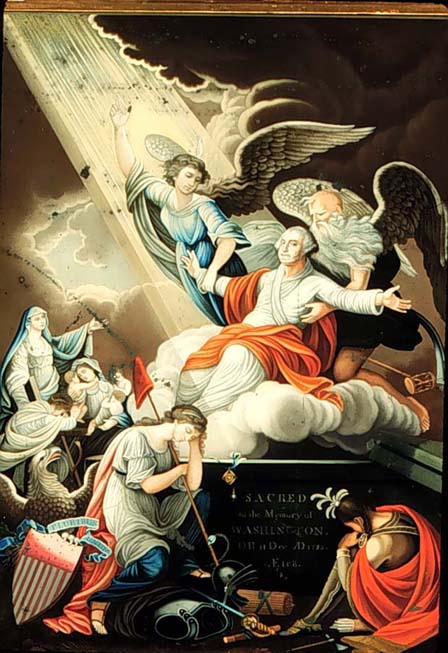
Historical Method is a class required of all history majors in which we study the history of the art and science of researching and writing history. We have readings from various historical works written throughout history, (fascinating) case studies in United States history that illuminate various points and problems in researching the past, and lectures from all the members of the department on historiography as it relates to their fields of specialization. About a month or so ago, in anticipation of Dr. Miller’s lectures on Early American historiography, we read excerpts from Parson Mason Weem’s Life of Washington and George Bancroft’s History of the United States. They were pretty amusing, to say the least. Parson Weems struck me as part historian, part hagiographer, and part Dr. Spock; his biography, as Dr. Miller explained, served to create the larger-than-life Founding Father that we know and love and was part of the general atmosphere of idolizing all of the founders. Weems was pretty clear in his writing that one should follow George’s father’s parenting techniques if one wants to raise children who are as virtuous as the great George Washington, and as an example of this great virtue, Weems provides the anecdote of George chopping down the cherry tree and then owning up to it when questioned by his father. This incident, along with many of Weem’s other mythic episodes, didn’t actually happen. This ideal continued throughout the 19th century, and even into our own day, and is present in art as well as writing. Dr. Miller showed us some pretty amusing images extolling George Washington, Brenna and I thoroughly enjoyed The Apotheosis of Washington (check it out here. You can also see it illustrating an article in the issue of Newsweek dated March 17, 2008). If you look closely at the left side of the picture, you can see the Virgin Mary looking on. It also looks like George is rising in glory out of a tomb while soldiers look on (sound familiar, especially this weekend?). Don’t get me wrong, I admire George Washington a lot, and there is definitely a lot we can learn from him, but the cult of George Washington and of the other Founders can be slightly over the top. And it’s still alive and well today.
George Bancroft was even more interesting than Parson Weems. He wrote about how every event during the entire 300 year history of colonial America was moving toward the revolution, and even the early 17th century settlers had freedom on their minds in some way. I was most amused when he started talking about freedom as “the breath of life,” how “a band of exiles, keeping watch by night, heard the glad tidings” brought by the revolution, and the prophets declaring these ideas. His idea of the revolution is a divinely ordained event that he likened to the coming of Messiah, and the language he used illustrated this belief even more than what he said about it. Bancroft did make some good points about how the colonial leaders believed that the British Parliament did not have the knowledge or the ability to govern the colonies by the 1760s and 1770s, which are points that I think most historians would consider valid and relevant; unfortunately, these kernels of substance are generally lost among his messages of deliverance through Washington and the other Founders. When discussing the Bible, the term “typology” refers to the study of events that prefigure the coming of and ministry of Jesus as the Messiah, especially His death and resurrection, like the deliverance of Israel from slavery in Egypt can be understood as a type of the salvation of mankind won by Jesus. Apparently, in the minds of Bancroft and his ilk, Jesus was a type of George Washington.
So that’s a sampling of Historical Method. We’ve also heard lectures about Hegel, Ranke, Marx (the best explanation of Marxism that Brenna and I have ever heard), how history came to be a profession, and twentieth-century debate between Consensus and New Left/Revisionist historians. We’ve also discussed the use of psychological analysis, interviews, and photographs in history, and we will soon have our exam and write our introductory thesis chapters. In other news, there was an article in the Baltimore Sun this past week about a recent survey that concluded that college students experience a lot of stress. It’s a pretty funny article and my classmates and I can attest to its accuracy, although we’re shocked that it seems to have taken this long for someone to declare that which is incredibly obvious. To read it, click here.
Hopefully one of us will write again soon about a conference we went to a few weeks ago and the lecture we will attend this coming Tuesday, but until then, have a very happy Easter!
Yes, it has been a long time since either of us has written, and you have our sincere apologies. We have been suffering from blogger’s block and more urgent historical matters have also captured our attention (like thesis prospectuses and outlines and other papers…..) But I had some thoughts on our studies in Historical Method that I wanted to share.
Historical Method is a class required of all history majors in which we study the history of the art and science of researching and writing history. We have readings from various historical works written throughout history, (fascinating) case studies in United States history that illuminate various points and problems in researching the past, and lectures from all the members of the department on historiography as it relates to their fields of specialization. About a month or so ago, in anticipation of Dr. Miller’s lectures on Early American historiography, we read excerpts from Parson Mason Weem’s Life of Washington and George Bancroft’s History of the United States. They were pretty amusing, to say the least. Parson Weems struck me as part historian, part hagiographer, and part Dr. Spock; his biography, as Dr. Miller explained, served to create the larger-than-life Founding Father that we know and love and was part of the general atmosphere of idolizing all of the founders. Weems was pretty clear in his writing that one should follow George’s father’s parenting techniques if one wants to raise children who are as virtuous as the great George Washington, and as an example of this great virtue, Weems provides the anecdote of George chopping down the cherry tree and then owning up to it when questioned by his father. This incident, along with many of Weem’s other mythic episodes, didn’t actually happen. This ideal continued throughout the 19th century, and even into our own day, and is present in art as well as writing. Dr. Miller showed us some pretty amusing images extolling George Washington, Brenna and I thoroughly enjoyed The Apotheosis of Washington (check it out here. You can also see it illustrating an article in the issue of Newsweek dated March 17, 2008). If you look closely at the left side of the picture, you can see the Virgin Mary looking on. It also looks like George is rising in glory out of a tomb while soldiers look on (sound familiar, especially this weekend?). Don’t get me wrong, I admire George Washington a lot, and there is definitely a lot we can learn from him, but the cult of George Washington and of the other Founders can be slightly over the top. And it’s still alive and well today.
George Bancroft was even more interesting than Parson Weems. He wrote about how every event during the entire 300 year history of colonial America was moving toward the revolution, and even the early 17th century settlers had freedom on their minds in some way. I was most amused when he started talking about freedom as “the breath of life,” how “a band of exiles, keeping watch by night, heard the glad tidings” brought by the revolution, and the prophets declaring these ideas. His idea of the revolution is a divinely ordained event that he likened to the coming of Messiah, and the language he used illustrated this belief even more than what he said about it. Bancroft did make some good points about how the colonial leaders believed that the British Parliament did not have the knowledge or the ability to govern the colonies by the 1760s and 1770s, which are points that I think most historians would consider valid and relevant; unfortunately, these kernels of substance are generally lost among his messages of deliverance through Washington and the other Founders. When discussing the Bible, the term “typology” refers to the study of events that prefigure the coming of and ministry of Jesus as the Messiah, especially His death and resurrection, like the deliverance of Israel from slavery in Egypt can be understood as a type of the salvation of mankind won by Jesus. Apparently, in the minds of Bancroft and his ilk, Jesus was a type of George Washington.
So that’s a sampling of Historical Method. We’ve also heard lectures about Hegel, Ranke, Marx (the best explanation of Marxism that Brenna and I have ever heard), how history came to be a profession, and twentieth-century debate between Consensus and New Left/Revisionist historians. We’ve also discussed the use of psychological analysis, interviews, and photographs in history, and we will soon have our exam and write our introductory thesis chapters. In other news, there was an article in the Baltimore Sun this past week about a recent survey that concluded that college students experience a lot of stress. It’s a pretty funny article and my classmates and I can attest to its accuracy, although we’re shocked that it seems to have taken this long for someone to declare that which is incredibly obvious. To read it, click here.
Hopefully one of us will write again soon about a conference we went to a few weeks ago and the lecture we will attend this coming Tuesday, but until then, have a very happy Easter!
Wednesday, February 27, 2008
The Power of the Press
With my apologias out of the way, allow me to actually blog. That is, if you are not completely shunning us by this point, and act for which I would definitely not blame you.
Over the weekend, I had two interesting run in's with good journalism. The first was via a clipping from the Chicago Tribune which my mother sent me last week. The article was deploring the sad state of historical education in both the United States and England. Apparently, 23% of British teenagers do not believe in Winston Churchill. I'm not even sure how that is possible. How do you not believe in Winston Churchill? That would be like an American teenager not believing in FDR. That goes beyond the kind of ignorance that leads many U.S. teens to be unable to identify the three branches of American government. At least they are not claiming that our government does not exist. They simply feel that knowing the names of the Three Stooges is more important. Having that sort of arcane knowledge myself, how can I possibly blame them? But Winston Churchill is not Santa Claus. I have an image in my head of some proper British mother sitting down her 10 year old daughter and saying, "I'm sorry Sally, but Winston Churchill is not real." My hope is that the poor child would cry. She should cry. Because it is a lie.
Now, 47% percent of these same British teens believe that Richard the Lionheart is a fictional character. This one, I can understand. Richard lived an extremely long time ago. He spent very little time in England and could not even speak English. As my roommate said, "Someone in the Robin Hood stories has to be fictitious, and it isn't going to be Robin Hood." And it is through the Robin Hood stories that most of these teens probably know who Richard is. So I don't blame them so much for this one, though the part of my heart that belongs to medieval England is crying a little.
For anyone who is interested, you can find the article here.
My other run in with wonderful journalism was because of assigned reading for school. Let me first say that this has been a banner semester for academic reading. Not only am I reading The Silmarillion, The Hobbit, and The Lord of the Rings, I have also been reading fantastic novels for both my Modern German history class and for Latin American Literature as History. However, I am beginning to appreciate breaks from the novel reading,and one came when we began to read a new book for Modern Germany, called What I Saw: Reports from Berlin 1920-1933. It is a collection of newspaper columns about Berlin by an Austrian journalist named Joseph Roth, and it has been translated from the original German.
Aside from the historical interest I have in the articles, I cannot get over the fact that they represent damn good writing. In his descriptions of everything from really large department stores (as opposed to simply large department stores) to the local homeless shelter, he uses turns of phrase that ring of poetry. He also brings a new prospective to everything, such as how God must have invented sand just for the enjoyment and education of children and how it must have been a whim of fate that made such a disorganized city as Berlin capital of the whole German Reich.
Whether or not any of you care about German history, if you simply enjoy reading (as I know many of you do), you will be doing yourself a major favor if you read this book. I cannot do justice to it in my description.
Well, that is my blog for the day. We are presenting papers at the Phi Alpha Theta conference this Saturday, and I imagine that one of us will want to blog about that. So keep checking back and, with luck, we will be back with you soon.
Brenna
Over the weekend, I had two interesting run in's with good journalism. The first was via a clipping from the Chicago Tribune which my mother sent me last week. The article was deploring the sad state of historical education in both the United States and England. Apparently, 23% of British teenagers do not believe in Winston Churchill. I'm not even sure how that is possible. How do you not believe in Winston Churchill? That would be like an American teenager not believing in FDR. That goes beyond the kind of ignorance that leads many U.S. teens to be unable to identify the three branches of American government. At least they are not claiming that our government does not exist. They simply feel that knowing the names of the Three Stooges is more important. Having that sort of arcane knowledge myself, how can I possibly blame them? But Winston Churchill is not Santa Claus. I have an image in my head of some proper British mother sitting down her 10 year old daughter and saying, "I'm sorry Sally, but Winston Churchill is not real." My hope is that the poor child would cry. She should cry. Because it is a lie.
Now, 47% percent of these same British teens believe that Richard the Lionheart is a fictional character. This one, I can understand. Richard lived an extremely long time ago. He spent very little time in England and could not even speak English. As my roommate said, "Someone in the Robin Hood stories has to be fictitious, and it isn't going to be Robin Hood." And it is through the Robin Hood stories that most of these teens probably know who Richard is. So I don't blame them so much for this one, though the part of my heart that belongs to medieval England is crying a little.
For anyone who is interested, you can find the article here.
My other run in with wonderful journalism was because of assigned reading for school. Let me first say that this has been a banner semester for academic reading. Not only am I reading The Silmarillion, The Hobbit, and The Lord of the Rings, I have also been reading fantastic novels for both my Modern German history class and for Latin American Literature as History. However, I am beginning to appreciate breaks from the novel reading,and one came when we began to read a new book for Modern Germany, called What I Saw: Reports from Berlin 1920-1933. It is a collection of newspaper columns about Berlin by an Austrian journalist named Joseph Roth, and it has been translated from the original German.
Aside from the historical interest I have in the articles, I cannot get over the fact that they represent damn good writing. In his descriptions of everything from really large department stores (as opposed to simply large department stores) to the local homeless shelter, he uses turns of phrase that ring of poetry. He also brings a new prospective to everything, such as how God must have invented sand just for the enjoyment and education of children and how it must have been a whim of fate that made such a disorganized city as Berlin capital of the whole German Reich.
Whether or not any of you care about German history, if you simply enjoy reading (as I know many of you do), you will be doing yourself a major favor if you read this book. I cannot do justice to it in my description.
Well, that is my blog for the day. We are presenting papers at the Phi Alpha Theta conference this Saturday, and I imagine that one of us will want to blog about that. So keep checking back and, with luck, we will be back with you soon.
Brenna
I Guess I Lied
Hello all. It looks as though I was overly optimistic when I announced that our blogging hiatus was over. It apparently was not. That might have something to do with the fact that we have been having one busy semester. We're taking a class called Historical Method in which we are begining to write our senior theses and I know that I have been doing a lot of reading and writing for my classes, as has Gillian.
I hope that we will finally start blogging again. We'll see how it goes this time...
I hope that we will finally start blogging again. We'll see how it goes this time...
Wednesday, January 23, 2008
Hiatus Over
Hello to all of our lovely blog reading community. Now that Winter Break is over, we are back. We have not, however, completely settled on a blogging schedule for this semester so, when we do (which should be by the end of this week) we will let you know what it is. Until then, we appreciate that you are all still reading and we promise to bring some exciting history factoids your way this semester.
Just to add something historically fun, on this day in 1849, Elizabeth Blackwell was awarded her M.D., thus becoming the first female doctor in the United States.
Brenna and Gillian
Just to add something historically fun, on this day in 1849, Elizabeth Blackwell was awarded her M.D., thus becoming the first female doctor in the United States.
Brenna and Gillian
Saturday, December 8, 2007
How Capitalism Stole Christmas…
And we’re not talking about stores decorating before Thanksgiving (though just ask Gillian about it). No, we’re talking about How the Grinch Stole Christmas as analyzed from a socio-political perspective by sleep-deprived college students the weekend before finals.
 The Grinch – He represents all that is wrong with capitalism. He is not satisfied until he has everything (he stole the last crumb from the mouse). He exploits and abuses the common, working man (see: Max). His small heart shows his lack of moral values, while his tight shoes represent the restrictive nature of operating within a system predicated on materialism and selfishness.
 Whoville – Whoville is a communist workers' utopia. All of the Whos share everything, from toys to food. They dine at a communal table and eat of the same food, with everyone getting his fair share and no one profiting at another’s expense. As the roast beast is sliced, each person passes it down, looking out for everyone else before taking care of himself. Their ability to enjoy Christmas without objects proves that their lives are based on society and moral strength, not materialism.
 Max – Max is the common man. He is trampled on and taken advantage of by the Grinch. He sticks with it, though, because he doesn’t know any better. When he is “pulling” the Grinch’s sled, he is representing the Red Queen theory of economics*: he must keep running faster and faster to stay ahead of the sled. This scene also shows that the Grinch only profits by taking advantage of Max’s labor.
 Cindy Loo Who – She represents the questioning youth who wants to try new ideas. Her confrontation with the Grinch over the Christmas tree and what he tells her shows the lies capitalists tell to brainwash the masses. When the Grinch says he’s taking the tree to fix the light, but he’ll bring it back, he is representing monopolies snapping up smaller companies to decrease competition.
In the end, the Grinch does not turn away from capitalism; he brings back all of the Christmas trappings, showing that he still sees them as essential. However, he has become a moral capitalist, shown by his equal slicing of the meat, which demonstrates fair labor practices. Max gets the first slice of roast beast, showing that in this new society, the needs of the common man are looked out for. By breaking bread with the Whos, the Grinch is saying that he now realizes that he and the Whos can work together as part of the same global community, despite their different political/economic beliefs.
Well, there you have it: proof that our brains are fried. Somewhere, our parents are wondering if this is the only result of our expensive education…
Also, we apologize for the lack of posts lately. We just finished the last week of classes and we are now preparing for finals week. As history majors, we do have scholastic concerns to deal with.
We will be back soon, with a whole slew of holiday themed posts (keep an eye out for the history of that festive drink, eggnog, as well as our favorite holiday songs).
Happy Holidays!
Brenna & Gillian
*This theory is based on a scene from Through the Looking Glass by Lewis Carroll. See Chapter 2, “Live Flowers.”
 The Grinch – He represents all that is wrong with capitalism. He is not satisfied until he has everything (he stole the last crumb from the mouse). He exploits and abuses the common, working man (see: Max). His small heart shows his lack of moral values, while his tight shoes represent the restrictive nature of operating within a system predicated on materialism and selfishness.
 Whoville – Whoville is a communist workers' utopia. All of the Whos share everything, from toys to food. They dine at a communal table and eat of the same food, with everyone getting his fair share and no one profiting at another’s expense. As the roast beast is sliced, each person passes it down, looking out for everyone else before taking care of himself. Their ability to enjoy Christmas without objects proves that their lives are based on society and moral strength, not materialism.
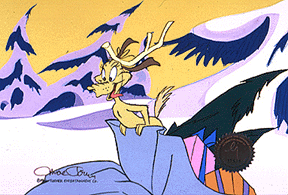 Max – Max is the common man. He is trampled on and taken advantage of by the Grinch. He sticks with it, though, because he doesn’t know any better. When he is “pulling” the Grinch’s sled, he is representing the Red Queen theory of economics*: he must keep running faster and faster to stay ahead of the sled. This scene also shows that the Grinch only profits by taking advantage of Max’s labor.
 Cindy Loo Who – She represents the questioning youth who wants to try new ideas. Her confrontation with the Grinch over the Christmas tree and what he tells her shows the lies capitalists tell to brainwash the masses. When the Grinch says he’s taking the tree to fix the light, but he’ll bring it back, he is representing monopolies snapping up smaller companies to decrease competition.
In the end, the Grinch does not turn away from capitalism; he brings back all of the Christmas trappings, showing that he still sees them as essential. However, he has become a moral capitalist, shown by his equal slicing of the meat, which demonstrates fair labor practices. Max gets the first slice of roast beast, showing that in this new society, the needs of the common man are looked out for. By breaking bread with the Whos, the Grinch is saying that he now realizes that he and the Whos can work together as part of the same global community, despite their different political/economic beliefs.
Well, there you have it: proof that our brains are fried. Somewhere, our parents are wondering if this is the only result of our expensive education…
Also, we apologize for the lack of posts lately. We just finished the last week of classes and we are now preparing for finals week. As history majors, we do have scholastic concerns to deal with.
We will be back soon, with a whole slew of holiday themed posts (keep an eye out for the history of that festive drink, eggnog, as well as our favorite holiday songs).
Happy Holidays!
Brenna & Gillian
*This theory is based on a scene from Through the Looking Glass by Lewis Carroll. See Chapter 2, “Live Flowers.”
Subscribe to:
Posts (Atom)